This text was originally written on the occasion of the 31st International Adana Golden Boll Film Festival’s and published in the festival catalogue.
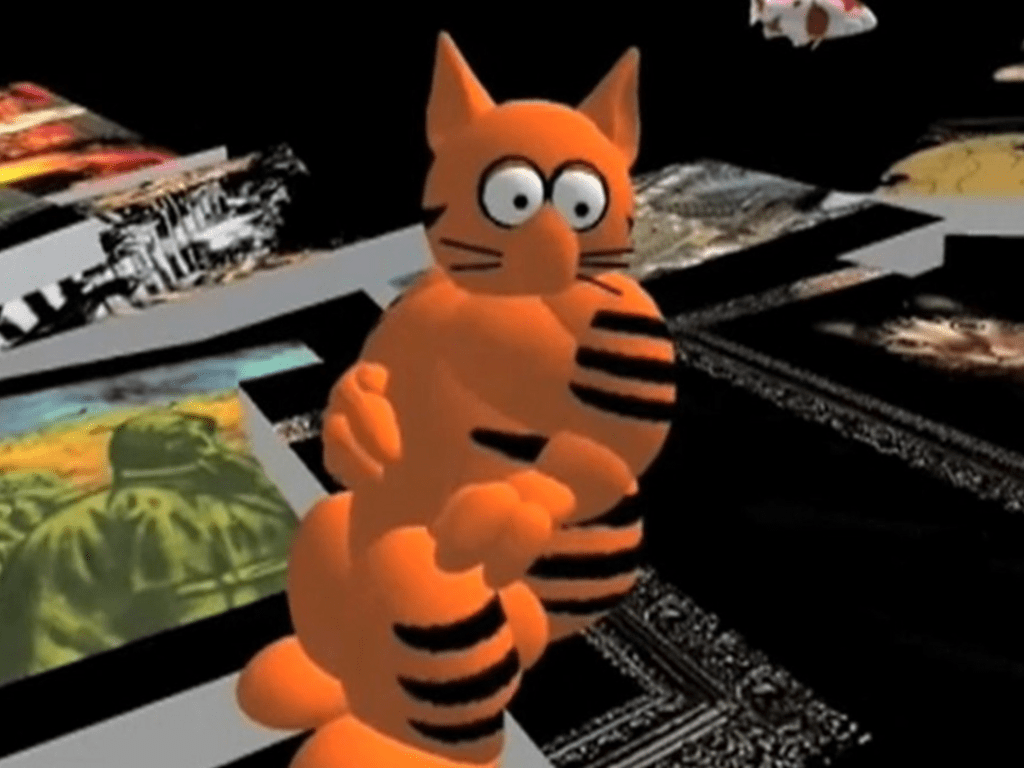
Christian Marker, Sandor Krasna, Fritz Markassin, Jacopo Berenzini, Sergei Murasaki, Hayao Yamaneko, Kosinski, and many other names… Christian Bouche-Villeneuve by birth, but as we know him best, Chris Marker. A master of disguise and disappearance, he is a figure of self-induced obscurity—a chimera made of a cat, an owl, and a computer, who fragments his existence by hiding behind different avatars, identities, and names, making it increasingly impossible to understand his oeuvre as a coherent and comprehensible whole. The idea of fragmentation, observable in any work bearing Marker’s or his multiple alter egos’ signatures—whether in essay films, travelogues, or late-period multimedia work—paradoxically serves as a basis for unpacking his artistic vision. This is not to suggest that the artist is to be perceived as a jigsaw puzzle where images, sounds, and texts are meant to be assembled to ‘complete’ him, but rather, these elements function as compasses, guiding us so that we can lose ourselves in his art.
When it comes to Chris Marker’s personal background, alluding to his French identity has always felt somewhat odd, especially considering he was born in the famously bourgeois Parisian suburb of Neuilly-sur-Seine. There was an unbridgeable chasm between what his milieu represented in society and the images he wished to create of himself —even within the context of the ‘Left Bank Group’ associated with the French New Wave — a movement he aligned with both artistically and ideologically—the cinema of Chris Marker always suggested a distance, an inadequacy. ‘An international observer,’ as we might call him, his explorations, however, never directly targeted the countries he was obsessed with, but rather the images of those countries that existed in a different realm—a world of appearances.
At the end of the 1950s, Marker began developing his idiosyncratic film essay form and embarked on his “travels by [way of] images”—camera travellings much less. “I am writing to you from a distant country,” Marker would open his seminal Letter from Siberia (Lettre de Sibérie, 1957). Yet, the singular first-person perspective that gave momentum to the travelogue concealed an elusive, convoluted, and polyphonic narrative, within the exact words, first penned by Henri Michaux, later appropriated by Marker, and finally voiced through the commentary of Georges Rouquier. Who exactly was this person who spoke to us from a distant country? And was this distant country really Siberia? Sent to create a conventional, cliché-packed documentary, Marker returned with images that were unlikely to please either the West or the Soviets—impressions that brought the distant close and made the unknown familiar: engraving facsimiles of mountains, seas, streets, buildings, people, and animals on the celluloid surface.
For Marker, who was acutely aware of both the freedoms and limitations inherited from the Lumières’ cinematic apparatus, Letter from Siberia served as a playful and intelligent means to misappropriate and manipulate the visual and textual vocabulary of orientalism and exoticism. Following a formal lineage that extended from Raymond Queneau’s Exercises in Style to Kuleshov, Letter from Siberia would become a tour de force of montage, exemplified by a scene where Marker reiterated the same images using three different tones of address: an overtly positive, an overtly negative, and a purportedly objective one. Meaning exceeds spaces, objects, or beings, the film suggests, germinating only through and within their representations as images—where ideologies, politics, prejudice, desire, irony, or affection, whether intentional or not, seep through the clouded, enchanted, or wayward eyes of the traveler.
After engaging in militant and collective forms of cinema in the late sixties and throughout the seventies with groups like SLON / ISKRA, Marker would return to his solo travels in the eighties. Just twenty-six years later, he continued to reflect on his position and its inner conflicts—as the traveler who brought back all those sounds and images from distant countries like Japan, Cape Verde, or Guinea-Bissau. Given that they were shot by a white French man, was there truly a way to capture experiences and impressions without stealing them from the people to whom they belonged? How could one avoid adorning these images with fantasies, speculative stories, or cultural, ideological, and political discourses tinged with naïve exoticism? And if not, why shouldn’t one? As can be seen in Sans soleil, Marker solved this by fragmenting the self, muddling the boundaries between the traveler, the narrator, and the filmmaker. Sans Soleil is built on an epistolary structure, consisting of letters written by a cameraman named Sandor Krasna. However, Krasna’s letters are narrated by a woman—to whom the letters were addressed—who, through a very peculiar form of indirect speech, would relay Krasna’s words with recurring statements like “he told me” or “he wrote to me.” From the very beginning of the film, Marker seems to try to conceal his voice on the textual level. But what exactly would stop one from perceiving these machinations as clues for the audience to help them find him, the auteur? Amidst this continuous game of hide-and-seek, a Cape Verdean woman finally manages to capture Marker, the filmmaker. In a scene that stands as one of the most powerful confrontations in cinema history, she gazes directly into the camera while Marker’s curious, insistent, and almost greedy lens stares at her as if to say, “Caught you!” To which the woman’s unwavering and confident gaze responds, “No, I caught you!”
The indirect expressions of the narrator in Sans Soleil are written in the language of the memory, where, as the film points out, it is difficult to “discover immediately that the vertigo of space, in reality, stands for the vertigo of time.” Time is indeed another variable to consider when it comes to images and their ownership. We never process the images we see on the screen as immediate and direct reproductions of any given reality—nor are they, in fact—but rather perceive them through the flawed lenses of the human mind. Continuously transferring experiences from the past to the present, while forming new connections and abandoning some old ones, or at times betraying its own narratives, Sans Soleil reveals the mechanics of the mind—the leaking vessel of memory. In Marker’s cinema, reminiscing the past in the present moment is always accompanied by a clear awareness of a future incessantly at work, pushing the present into the past. This two-way movement within memory is also succinctly exemplified in La Jetée (1962). Mostly visible if one manages to peel away the dystopian or sci-fi labels often associated with it, the irony of our memory is that the past and what we once called the future end up in the same dark, bleak corners of the mind. La Jetée is often referred to as a photo-novel, composed solely of photographs, with a tiny exception. The very static nature of the work transposes the constant interplay between different temporalities into the realm of pre-digital cinematic ontology. These photographic blocs, or “cinematograms” as Philippe Dubois calls them, remind us that cinematic expression, at its core, is grounded in still images, and that the impression of movement actually stems from the ‘persistence of vision’—the visual continuity created by the successive arrangement of still images. Therefore, the cinematic image is composed of traces of the future left in the past.
In Sans Soleil, Sandor Krasna mentions a film he will never make about a visitor from the year 4001—a time when humanity has perfected memory—who travels back to the present, which is now the past. Although Marker acknowledges that perfect memory is unattainable, his imaginary visitor relates to us, the spectators of the future, who would be more obsessed with the idea of perfect memory than ever before, and to a future Chris Marker, who would soon dive into the then-unexplored confines of the digital realm. While suggesting that images will gradually replace memory, Sans Soleil takes this idea further by designating electronic and digital technologies as new forms of memory. In Sandor’s letters, we learn about his friend Hayao Yamaneko (who, of course, is none other than Marker himself), who uses his synthesizer to transport images into what he calls “the zone.” “If the images of the present don’t change, then change the images of the past,” advises Yamaneko. Similarly, in Level Five, the protagonist Laura, who is trying to complete her partner’s unfinished game about the Battle of Okinawa, resorts to images of the past.
Level Five is a hybrid work of documentary and fiction, where Marker sees himself as one of the “Neanderthals” of cyberspace. In this realm, the fragmented “self” is gradually replaced by “them”—collateral victims of history who now exist only in images, testimonies, and the realm of memory. Contrasting with Marker’s oeuvre, often described as cerebral cinema with layers of signs, references, and intertextual mysteries, Level Five exudes an unquantifiable sense of melancholy and loss. Laura eventually fails in her attempts to save the Okinawans through the game and to rewrite history. The network through which she conducts her research, called Optional World Link, leads her deeper into losing herself. Overwhelmed by the weight of her knowledge, Laura becomes increasingly isolated and distant, eventually vanishing. Even the computer does not know her whereabouts, let alone remember her. This is how the world of appearances work— a world where confronted by the ferocious beast of history, memory, ultimately, falls short.
Note: I started translating the original text I had written in Turkish due to practical reasons. Gradually, the whole process began to resemble an “exercise in style”, where the writer, usually referred to in the first-person singular, seemed to adopt a different language—sometimes adding, sometimes removing words. One could not think of a better way to pay tribute to Chris Marker’s legacy. Here’s to Chris and his avatars, from us, the multiplied, fragmented selves.
 Öykü Sofuoğlu
Leave a comment