The conservative, authoritarian, and pro-Islamic AKP (Justice and Development Party), founded and led by Turkey’s current president Recep Tayyip Erdoğan, has been in power for 23 years to date. While their oppressive and unlawful rule has had a predominantly alarming and long-lasting impact on the country’s economic, social, and political climate—reaching an unprecedented level following the arrest of Istanbul’s mayor and future presidential candidate Ekrem İmamoğlu on March 19th, 2025—Turkey’s arts and culture scene, and in particular its film industry, has not been exempt either.
In Turkey’s case, one of the most disconcerting “collateral damages” of systemic oppression, institutionalized censorship and normalized corruption is the severe deterioration of collective memory—merging each singular and equally important act of violence, manipulation and connivance into a vast, indistinct mass of ‘late history”. The endeavor to outline the current state of cinema in Turkey is inevitably hindered by the impossibility of identifying a clear turning point, given how numerous those turning points have actually been—placing the writer in a perpetual impasse, left to wonder: “Where to begin?”
Where to begin? With the demonstration (and the ensuing occupation) against the demolition of Istanbul’s historic Emek movie theater, which later paved the way for the Gezi Park Protests—still remembered as one of the most inventive and resilient forms of collective political action in the country’s history? With the censorship faced by Reyan Tuvi’s documentary about the Gezi Park Protests, Yeryüzü Aşkın Yüzü Oluncaya Dek (Love Will Change the Earth), imposed by the Antalya Golden Orange Film Festival’s organizing committee in 2014? Or with Çayan Demirel and Ertuğrul Mavioğlu’s documentary Bakur (North), which follows the lives of PKK (Kurdistan Workers’ Party) guerrilla fighters, and was subjected to a similar form of censorship by the Istanbul Film Festival in 2015—on the highly unconvincing grounds that it lacked a “registration permit”—prompting a boycott of the festival by audiences, as well as 22 filmmakers who withdrew their films? Maybe with the suppression of the Golden Orange Film Festival’s National Competition in 2017 and 2018 by the AKP-led Antalya municipality, under the pretense of rebranding the festival with a more internationally focused identity, while in reality aiming to silence dissident and critical voices using the festival as a platform? How about with the sentence of 18 year-imprisonment that filmmaker and producer Çiğdem Mater was given, for a documentary she was allegedly preparing about the Gezi protests?
Enumerating all these attacks on freedom of speech and artistic expression is useful for shaking the dust off our short-term memory—but what truly matters is understanding how these successive and inherently connected events, rather than fueling a cumulative spirit of resistance and solidarity, ended up trapping our community in a vicious cycle of taking action, compromising our goals and values, and ultimately forgetting them. In this respect, film festivals provide us with a practical and valuable framework, as they intrinsically engage with public space, operate within it and depend on its visibility—unlike other components of the film industry apparatus, such as funding, production and distribution, where mechanisms of censorship and even self-censorship operate in far more insidious ways.
One point to retain is that there are three major players within Turkey’s film festival landscape: the Istanbul International Film Festival, the Antalya International Golden Orange Film Festival, and the Adana International Golden Boll Film Festival. Given the steadily declining numbers in movie theater attendance and a distribution economy increasingly shifting toward the financially safer option of streaming services, each of these festivals represents an indispensable financial opportunity for filmmakers and producers to sustain themselves within a viable creative economy. (In their latest editions, the Istanbul Film Festival awarded a €30,000 cash prize, while both the Golden Orange and Golden Boll festivals offered 1,500,000 TL—approximately €33,000—to the winner of their respective National Competitions.) The financial prospects and need for visibility become even more crucial for documentaries and short films, whose chances of reaching the public and generating monetary profit are far more limited. Antalya also hosts a co-production market, with work-in-progress, pitching, and development platforms—a sine qua non event for many producers and filmmakers developing future projects.
Of the three, the Antalya and Adana Film Festivals are both organized and funded by their respective municipalities, with the mayors serving as Festival Presidents and working in collaboration with the artistic directors and their programming teams. Until 2023, both festivals were also sponsored by the Ministry of Culture and Tourism and its General Directorate of Cinema. However, following accusations of censorship and the eventual cancellation of the Antalya Film festival, the Ministry withdrew its support. While the exact amount of government funding for either festival remains unknown, this situation highlights how the alignment—or lack thereof—between local and central governments can directly impact the artistic, political, and financial autonomy with which festivals, in an ideal world, should operate. Furthermore, it was the combined presence of an AKP-affiliated local government and an AKP-led central government that fueled growing discontent within the country’s film community, which had become increasingly politically vocal—both within and beyond their films—in the post-Gezi era. While the documentary form emerged as the primary vehicle for bearing witness to political and social unrest in Turkey during the 2010s, fiction films such as Emin Alper’s Abluka (Frenzy, 2015), Tolga Karaçelik’s Sarmaşık (Ivy, 2015), and Ceylan Özgün Özçelik’s Kaygı (Inflame, 2017) employed political allegory to translate the oppressive reality and the unresolved traumas of the past that continued to haunt the country
Boycotts by filmmakers, jury members, and journalists withdrawing their participation have been common throughout the history of the Antalya Film Festival. But in 2017 and 2018, the suppression of the National Competition sparked a more makeshift, experimental, and short-lived form of resistance: a group of film professionals decided to organize their own “National Competition,” independently of the festival. When Antalya elected a mayor from the main opposition party—CHP (Republican People’s Party)—many believed the tides were finally turning. With a new programming team and the National Competition reinstated, Turkey’s film community began to warm up to the festival again, giving little afterthought to its past shortcomings or to how the earlier boycott strategies might be improved—particularly around the urgent question: “How do we organize and resist in a way that is durable and impactful—without alienating one another, and with systemic change as the shared goal?”
What followed the cancelled 2023 edition—triggered by yet another censorship controversy—proved that these questions remain unanswered, and for some, not even asked. That year, the festival removed Nejla Demirci’s documentary Decree (Kanun Hükmü) from the national documentary competition. The film, which follows a teacher and a doctor who lost their jobs after the 2016 attempted coup, was pulled by the festival team on the grounds that one of the subjects was still undergoing legal proceedings, and the documentary could interfere with the process. Facing protests from jury members and filmmakers—and the beginnings of a boycott—the festival reinstated the film, only to be met with backlash from the Ministry of Culture and Erdoğan himself. The resulting pressure led to the festival’s eventual cancellation and a clash between the municipality and the festival’s programming team, with both sides accusing each other of mismanaging the crisis. Cut to 2024—with a new programming team in place, some members of the film community chose to participate in the festival, although general attendance and popularity were noticeably diminished. Others, unconvinced by the festival’s handling of the censorship issue, continued their boycott, accusing the former group of conformism.
The schism between groups of “conformists,” “dissidents,” and “compromisers” unfortunately forms a ubiquitous pattern across all facets of Turkey’s film industry. These positions fundamentally embody the range of responses a given community may adopt when confronted with an oppressive, sanctioning system: working within and benefitting from it; fully rejecting and resisting it by placing oneself outside of it; or attempting to bring about change from within while still opposing what it represents. However, in a small-scale and struggling independent film scene like Turkey’s, individuals often shift between roles and positions across different areas—with critics becoming filmmakers, filmmakers becoming programmers, or doing both at once. Moreover, in a professional environment where personal connections, networks, and interests—as well as conflicts, resentments, and long-standing vendettas—frequently shape decisions, positions, and power dynamics, the idea of being truly “outside” the system often feels inconceivable, if not outright utopian. Without underestimating the relentless efforts of countless programmers, filmmakers, producers, and critics who continue to work and create despite immense financial and political obstacles—with a sword of Damocles constantly hanging over their heads—it is time to stop repeating the worn-out mantra of “we’re all in the same boat” and to evacuate as soon as possible.
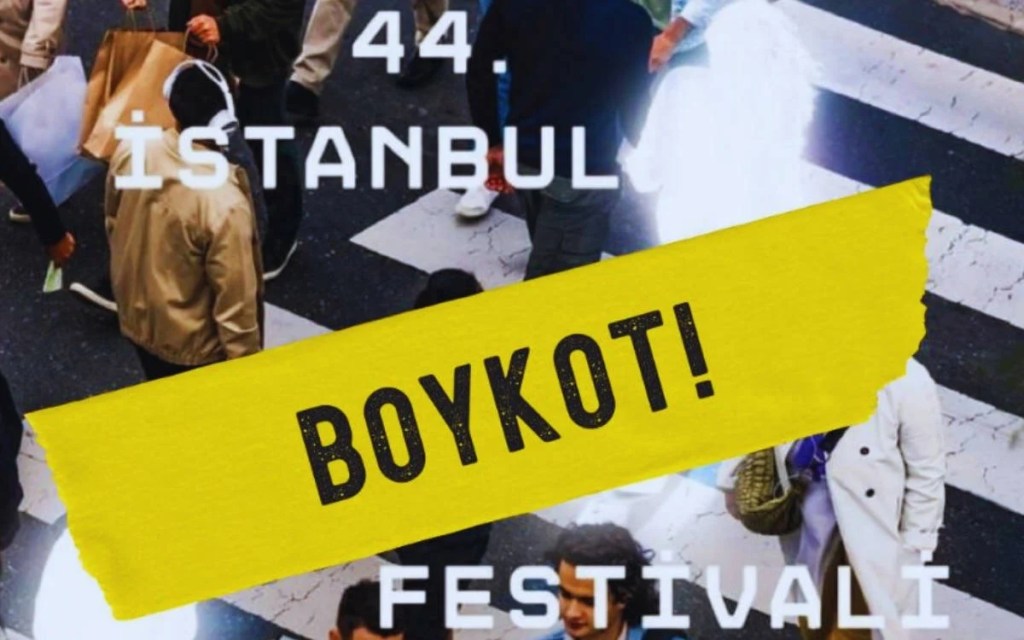
The 2025 edition of the Istanbul Film Festival, held amid widespread public boycotts and protests following Mayor İmamoğlu’s arrest, provided the most recent example of this stalemate. When the festival program was announced, the removal of a parallel section showcasing queer films prompted the Istanbul LGBTI+ Pride Week Committee to call for a boycott, denouncing the decision as outright censorship. The absence of the National Documentary Competition did not go unnoticed either—a decision that further undermines a cinematic form already in a precarious state. The festival stood its ground, framing these choices as programming decisions rather than political ones, and pointed to previous editions in which the same section had likewise not been featured.
Unlike film festivals overseen by local political bodies, the Istanbul Film Festival is organized by IKSV (Istanbul Foundation for Culture and Arts), which was founded by the Eczacıbaşı family—one of the wealthiest in Turkey. Their industrial conglomerate has invested in the country’s arts and culture sector for decades, eventually becoming something of a monopoly within the festival ecosystem. A growing discontent among audiences and film professionals regarding IKSV and the film festival had been looming for many years, accusing them of hiding behind cinephilia to mask a profit-driven, neoliberal, and favoritist mentality. However, the Istanbul Pride Week boycott call was largely taken up and amplified by the public and university students, while none of the professional bodies within the film industry took an official stance. Only individual members of the film community stated on social media that they would not attend—or, in the case of journalists, cover—this edition.
The festival took place uneventfully—if one can call it uneventful when a few screenings were canceled after the Istanbul Governorship deployed police forces to suppress a CHP-organized demonstration in solidarity with Gaza. Boycotters resented those who chose to attend; some didn’t care. Among those who did attend, some went about it as business as usual, some resented the boycotters—claiming their anger was misdirected and unwarranted—while others saw the festival as an opportunity to publicly denounce the unlawful imprisonment of Imamoğlu and many others. All things considered, the boycott proved to be inconsequential on a collective level.
Today, in light of the last two editions of the Berlinale and recent revelations about MUBI’s financial partner Sequoia Capital’s ties to Israel, the significance of boycotting as a political action—and its relevance within cinema-oriented organizations, companies, and institutions—opens up a discussion that extends far beyond Turkey’s national film industry and may initially seem unrelated. But they shouldn’t be treated as such, since different instances of boycott can inform and reinforce one another—helping us establish more durable, practical, and target-oriented forms of action without losing sight of the political, social, and cultural dynamics specific to Turkey. Building transnational or international networks of resistance can strengthen our sense of solidarity and community—and even prompt us to reconsider the symptomatic sectarianism within our own cinema ecosystem. But most importantly, it can contribute to constructing our collective memory of resistance—to find ways to honor and remember the unscreened or censored films, their creators, and those who stood in solidarity with them.
This article was originally published in Dutch, in issue #481 of Filmkrant.
 Öykü Sofuoğlu
Leave a comment