In the context of cinematic representation, the frame gives a sense of grounding. It contains and stabilizes the image; it directs the gaze. Even in the most puzzling configurations, the frame maintains the illusion of three-dimensional space, assuring the viewer that they are in familiar territory (with a few exceptions, such as Haneke’s Caché, where the supposedly immediate image is revealed to be a videographic one, thus complicating the layers of “cinematic reality”).
When the cinematic image gives room to digital screens, however, the possibilities multiply. Two-dimensional home screens, desktops, URLs, and folders often become playgrounds or houses of mirrors as the frame loses its bearings. Conforming to the modus operandi of the desktop essay form, Kevin B. Lee’s Afterlives unfolds on these slippery digital foundations. Lee’s almost obsessive, personally involved approach is less research than an exploration—an exploration whose paths—even the digital ones—take shape as he moves forward, recedes, digs deeper, stops and ponders, sometimes runs in circles, or lets others take the lead.
As the film positions itself in relation to Lee’s and Lého Galibert-Lainé’s Bottled Songs project, those who haven’t seen the latter might feel like latecomers to Lee’s meditations on ISIS’s propaganda videos, which contain extremely violent depictions of human massacres and the mass destruction of cultural and historical artifacts in Iraq and Syria. When one begins to consider the film’s narrative economy, it may seem that it doesn’t hold very well on its own and makes more sense as an extension (and/or expansion) of that earlier work. Personally, I thought that by using the Medusa statue both as the film’s entry point and as its mnemonic base (since it’s the external drive to which visitors can connect at Kunsthalle Mannheim), through which he reflects on the perpetration of violence and the possibilities of restoration, Lee places too much symbolic and metaphorical weight on it—far more than it can carry over the course of an 88-minute film.
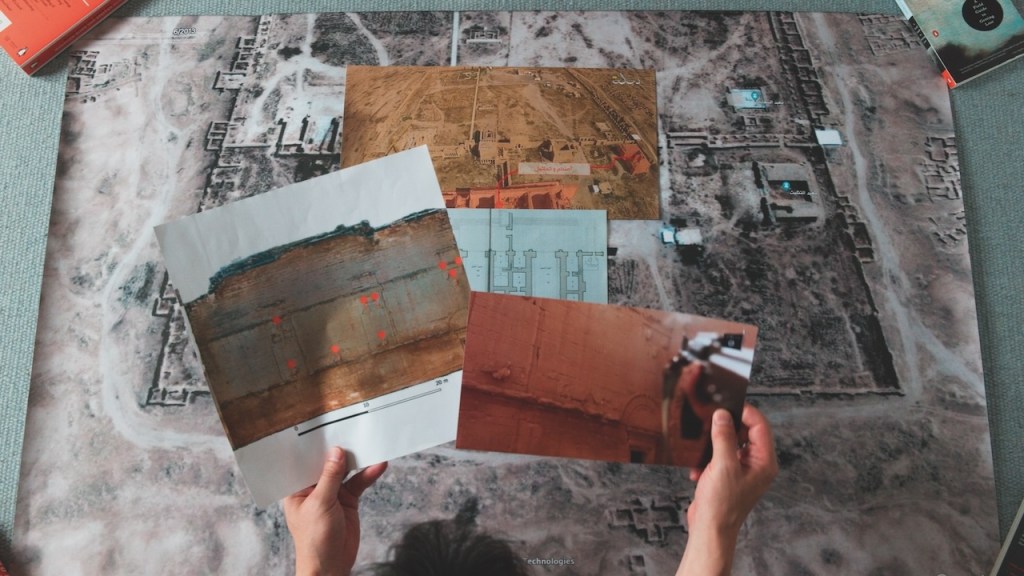
If Medusa—the one created by installation artist Morehshin Allahyari using 3D printing techniques—is the entry point and the compass, then the ISIS propaganda film Flames of War is the nauseating mystery he seeks to comprehend, or at least to “digest” as much as possible, and ultimately to “do something completely different with it,” to quote Nava Zarabian, the second of Lee’s interlocutors in the film. Although Lee’s propositions “to do something different” through analytical tools are very compelling in theory, I felt that the outcome of this gesture—whether on the editing software or when he cuts each word on paper and rearranges them—fails to create the desired impact. Or rather, the intentions are too pronounced to fuse into the fabric of the film; they stand out as unevenly expository.
Afterlives seems like an apt title on many levels, as it could designate, first, the afterlives of images of terrorism, which have seemingly disappeared from the surface level of the internet before being fed into gluttonous AI software that turns them into homogenized, flattened, polished simulacra—resurrected zombie images used to qualify, categorize, and identify what a terrorist would look and act like. Secondly—though actually being the centerpiece of Lee’s interrogations—it encompasses the afterlives of victims, both people and artifacts, and, as a moral duty, how their memory must be salvaged, preserved, and narrated. The concept of “violent care” that Lee mobilizes through Allahyari’s work is the most relevant and important aspect of Afterlives, as it allows the film to reach beyond ISIS propaganda and relate to other, more recent instances of violent care—mainly related to Palestine—at least for me as a person who has been trying to understand the vague sense of discomfort I felt upon watching films like Put Your Soul on Your Hand and Walk or The Voice of Hind Rajab.
And finally, it refers to the afterlives of the viewer—to what happens when a person is exposed, from a distance, to images of violence that leave them in a limbo state, simultaneously terrorized and desensitized. Often, those who receive these images—those who have the privilege of witnessing from the comfort of their homes merely an ounce of the terror that people actually endure—are themselves viewed as a homogeneous mass. Lee adopts a different approach, a risky one that, in different hands, could have easily disregarded the level of dehumanization these people endured and are still enduring. By insisting on showing the bodies and faces of people—starting with himself—who are exposed to terror by proxy, Lee reflects our own embodied vulnerability as spectators and, through subtler means, reminds us that we are as much privileged accomplices to this violence as he is.
 Öykü Sofuoğlu
Leave a comment